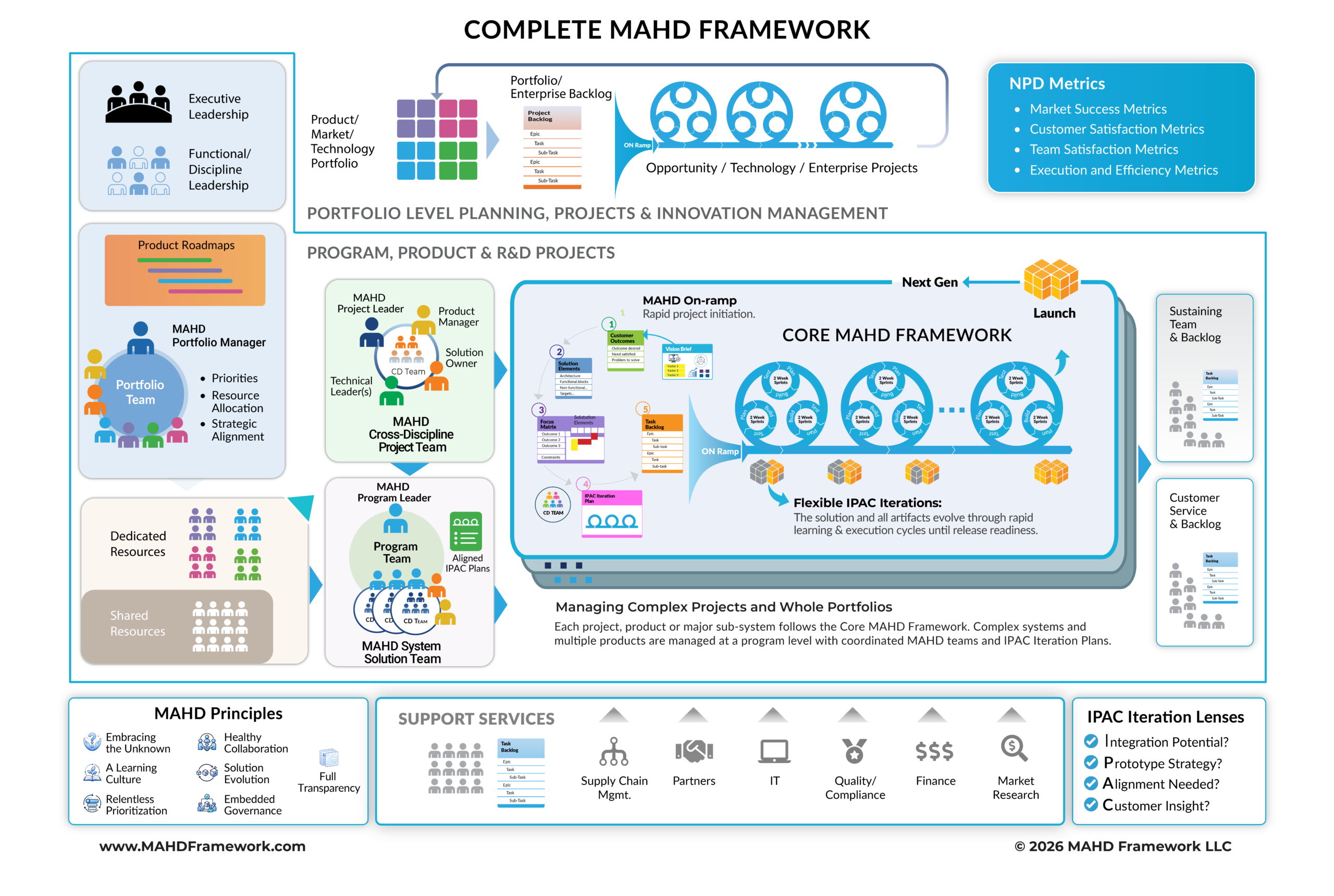
The Complete MAHD Framework provides the governance and agile methods needed to manage the entire product lifecycle while integrating seamlessly with other processes such as Stage-gate, Lean/Six Sigma or SAFe.
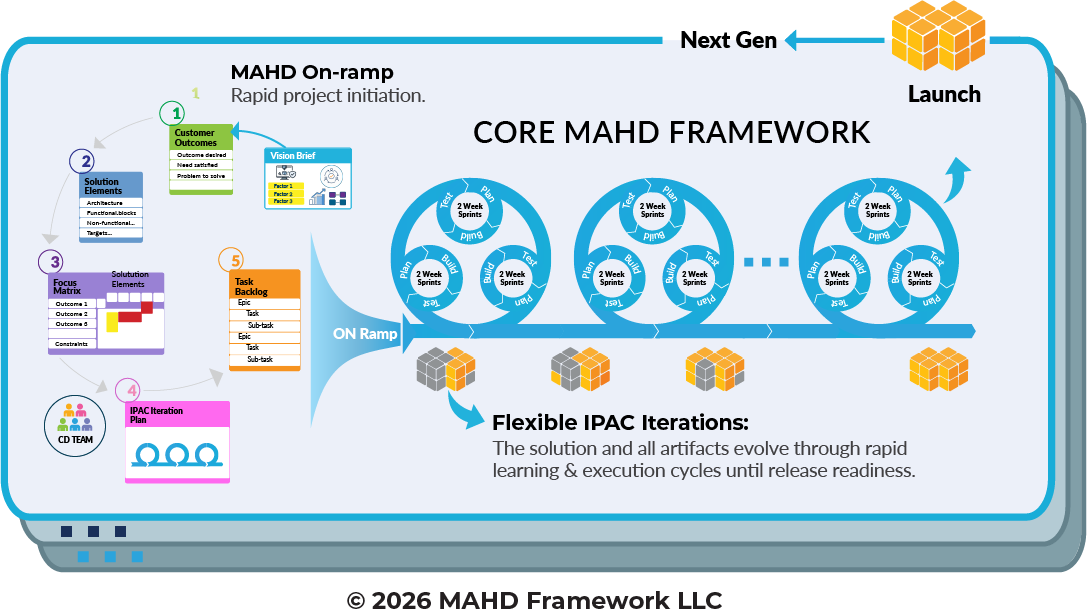
While the MAHD Core Framework focuses on methods for effectively managing individual development projects, the Complete MAHD Framework expands these capabilities with the governance, portfolio practices, and agile methods needed to select the right projects, optimize resources, and build sustainable engineering capabilities across the organization.
Complete MAHD extends agility beyond individual projects by connecting portfolio choices, the innovation pipeline, sustaining work, and scarce resources in one learning-driven operating system.
Turns strategy into a visible, adaptable portfolio of products, programs, and projects.
Creates a disciplined flow from emerging needs and ideas to validated development opportunities.
Applies MAHD learning cycles to installed products, customer issues, and lifecycle obligations.
Directs scarce people, expertise, and capacity to the work that matters most.
Central to any process is the need to set strategy, make resource decisions and support development teams. Agile principles and mindsets start at the top to help guide strategic planning and decisions at each stage of the NPD process.
The MAHD Framework helps teams manage product portfolios and innovation pipelines using agile principles. This allows teams and management to: <br>
1) Guide portfolio analysis and product selection and using rapid learning and execution cycles similar to any NPD project
2) Make incremental investments in advanced R&D and new products based on learning and demonstrable progress<br>
3) Apply the same MAHD On-ramp and agile project team formation and execution tactics for a holistic approach to NPD throughout the entire PLC.
With agile, there can be confusion as to what constitutes a product roadmap since plans are always flexible, and the backlog is intended to capture and prioritize new features.
However, hardware development requires more forward-looking thinking to anticipate architectures, technology, and product releases that may have long shelf lives. The MAHD Framework incorporates product roadmap planning as part of strategic planning and on-ramp activities while still staying true to agile principles.
Central to project success is the allocation of resources. The right people, at the right time, with the right focus. While Agile teams best run with dedicated team members, hardware developers, architects, designers, etc., can rarely be allocated entirely to a single project, the reality of shared resources is built into the MAHD Framework. Some considerations when allocating resources:
1) Use Iteration Planning to identify key resources you'll need to remove risk and focus on the highest priority attributes early
2) Ensure shared (part-time) resources on your teams participate in task development and estimating
3) When one critical resource is shared across too many projects, ask, "How might we help these teams be successful?"
Metrics become the yardstick with which your product development process will be measured and allow you to make focused improvements as you learn. We recommend establishing metrics in four dimensions:
1) Market success - forecast accuracy, ROI, margin, etc.
2) Customer satisfaction - net promoter score, ratings, competitor rankings, etc.
3) Team satisfaction - autonomy levels, morale ratings, etc.
4) Efficiency - speed from concept to market, decision-making speed, resource utilization, etc.
Large projects, such as complex products, systems, and product lines, need a MAHD team-of-teams approach. This requires some additional roles and coordination, including:
MAHD Program Manager - Team leader with MAHD skills and experience to lead multi-team programs with cross-team dependencies
Program Level Iteration Plan - Planning and executing an Iteration Plan for the full system and/or multiple products, often with shared resources
Program Level Team - Comprised of project team leaders (agile project managers and owners) and other key decision-makers
While some projects may require a continuous flow of product or systems releases that are managed with successive Iteration cycles, hardware development often ends with a discrete product launch. Once a product is in production, the MAHD Framework guides teams to:
1) Use agile and lean methods such as Kanban to manage and prioritize fixes, cost reductions, manage part changes, address quality issues, etc.
2) Help customer service teams apply agile and lean methods and incrementally improve customer satisfaction
3) Manage larger projects with the same core MAHD Framework and agile methods to align with development teams and the whole organization
Hardware-based products require a range of support from supply chain management to market research services throughout the development cycle as well as during the ramp-up to production. For project success, the right resources must work with product teams at the right time. The MAHD Framework helps optimize how these resources engage with product development teams to:
1) Align support services needs with R&D needs
2) Set priorities and structure tasks
3) Align timing and deliverables with product development
While the Complete MAHD Framework provides the governance and methods to manage the entire product development process, the MAHD Framework Core provides the basis for project excellence.
Discover how the MAHD Framework Core enables agile methods to deliver project success by clicking below.
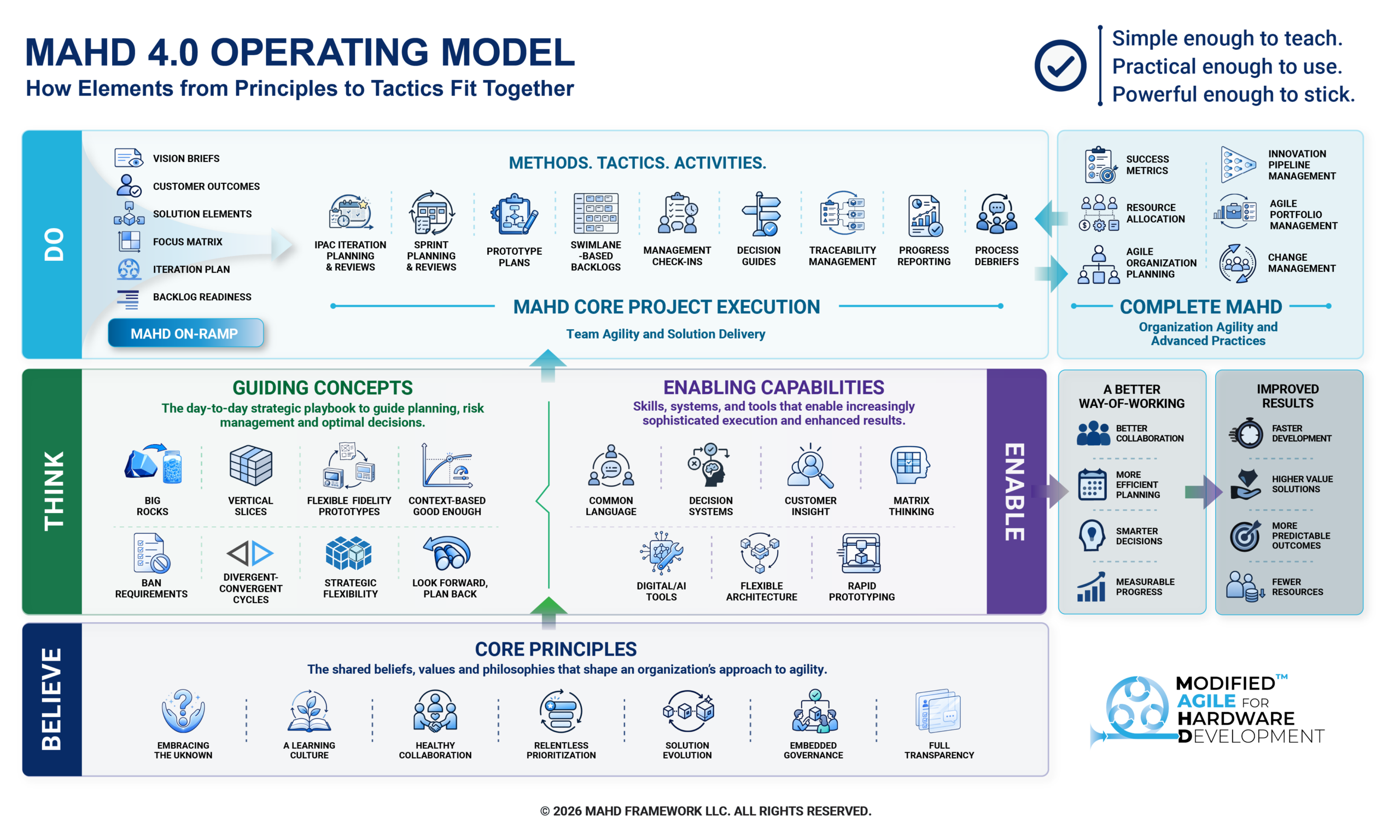
An essential addition to the MAHD Framework in release 4.0 was the addition of the MAHD Operating Model.
Based on insights from 100’s of projects and teams, it was clear that the most successful teams learned quickly how to embrace and leverage not just the tactics of MAHD, but the Guiding Concepts to guide how to best collaborate, set milestones and make decisions.
While the Operating Model can feel overwhelming at first glance, each Guiding Concept and Principle begins to form a common understanding, language and culture that becomes second nature to the team. Long term, it’s the Enabling Capabilities that provide the tools that deliver increasing benefits as the team and process matures.
Whether you are evaluating agile for hardware, ready to pilot a project, or looking for answers to specific challenges, we have resources to help you move forward in your agile journey.
Understand why hardware development requires a purpose-built agile approach.
Overview • Benefits
Comparisons
Explore customer results, industry applications, and MAHD ROI.
Customers • Industries
Case Studies • ROI
Build capability through training, and practical implementation support.
Training • Workshops Certification
Find answers to questions about MAHD, challenges, and how it might fit in your organization.
Browse FAQ • Resources
Contact Us
Learn how MAHD applies agile principles to the real world of hardware. Key elements, benefits, how to get started.

Offered the 2nd Tuesday of each month, this 90-Min Seminar is a great way to learn if MAHD is right for you.
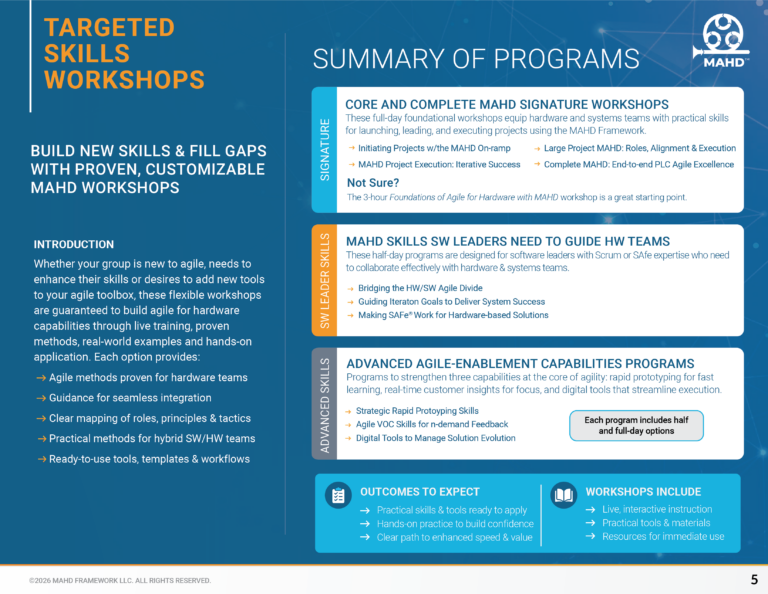
From basic to advanced skills, MAHD workshops provide the skills and tools to succeeed.

We’re here to help. Set up a complimentary 30-minute session with a MAHD expert to discuss your situation, goals and best path to success.