An Enhanced On-ramp for Faster, High-Velocity Project Starts
A project’s early direction shapes everything that follows. Before a team can execute effectively, it needs enough shared understanding to answer a few critical questions:
- What outcomes are we trying to achieve?
- What problem are we solving and for whom?
- What constraints, risks, and unknowns could most affect the path forward?
- Which solution possibilities deserve further exploration?
- What should the team learn, prove, or decide first?
These questions are rarely easy at the start of a hardware development effort. Teams may have an initial idea, a business need, or a broad project concept, but still lack alignment on strategic intent, critical unknowns, promising solution directions, or the right first steps.
Too often, teams either move too quickly into execution or spend too long trying to create complete requirements and a detailed plan before meaningful execution begins.
Neither approach is ideal.
Starting without enough alignment can create confusion, rework, and competing efforts. Attempting to define every detail upfront delays progress, reduces flexibility, and produces plans that quickly lose relevance as the team encounters the realities of the project.
A primary benefit of the MAHD Framework is helping teams strike this balance through the MAHD On-ramp. Its specific steps provide a productive middle ground: enough clarity to begin with confidence, while preserving the flexibility to learn and adapt.
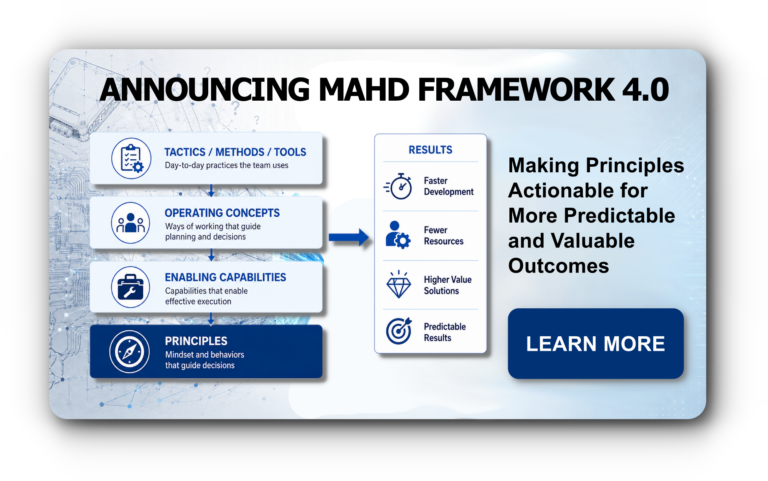
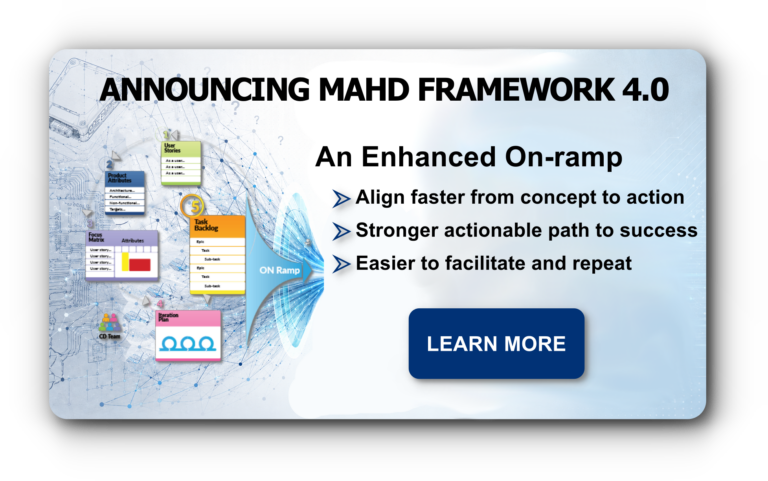
MAHD Framework 4.0 incorporates ten years of field experience across hundreds of projects to strengthen the On-ramp, making it faster to implement, easier to facilitate, and more intuitive across a wide range of project types.
MAHD On-ramp: A Better Start for HW-Based Projects
Regardless of their planning approach or intentions, hardware teams naturally face a wide range of uncertainties before all the answers are known.
A typical project may involve technical risks, evolving customer needs, cost targets, resource constraints, supplier considerations, regulatory requirements, system dependencies, and competing commercial priorities. The challenge is rarely a lack of opinions. It is aligning on which questions matter most, how to investigate them efficiently, how to agree on a shared path to success, and what the best first moves are.
The MAHD On-ramp provides a practical structure for moving from an initial opportunity or project concept toward clearer strategic intent, a common understanding of the solution space, and an actionable first-iteration plan.
This does not mean fully defining the solution before work begins or creating a detailed development plan. It means giving the team a shared view of what success looks like, what must be learned or resolved early, and where focused action can create the greatest value and reduce risk.
The enhanced MAHD 4.0 On-ramp helps teams clarify these essential elements with even greater consistency.
The following overview summarizes the MAHD On-ramp steps, followed by what has changed in MAHD 4.0 and why.
- Before beginning the On-ramp, teams develop a MAHD Vision Brief. This short, one- to two-page document clarifies the project’s strategic intent and aligns the executive, product, and project teams.
- Customer Outcomes – The Product Manager captures and prioritizes the key customers and stakeholders, along with their needs and desired outcomes.
- Solution Elements – The technical team responds by outlining a skeleton solution in the form of major solution elements.
- The real collaboration begins with the Focus Matrix. This team activity brings the perspectives together by identifying important connections between customer outcomes and solution elements, helping the team align on areas of risk and innovation.
- Using the Focus Matrix results, teams develop a preliminary Prototype Plan and Initial IPAC Iteration Plan, with an emphasis on aligned milestones for the first iteration.
- 5) The final On-ramp step prepares the Backlog Structure for execution. This is not a traditional work breakdown structure; it is the mechanism for planning and tracking work aligned with the needs of the project.
Through this focused set of activities, which can take from a few days to a couple of weeks, the team reviews constraints, challenges assumptions, and captures key questions likely to affect project outcomes.
The steps remain the same across projects, although the details within each activity vary. The purpose is consistent: create a common understanding of the project, agree on a path to success, and define a meaningful first iteration.
MAHD 4.0 On-ramp: Simple Changes, Powerful Results
While teams immediately see the value in each step of the MAHD On-ramp, release 4.0 introduces modest but important refinements that make each step clearer, easier to facilitate, and more repeatable across a wide range of project types.
The following table compares the current approach with the MAHD 4.0 enhancements. The purpose of each step remains unchanged and is included here for reference.
These changes are based on feedback and, in most cases, direct observation and team coaching over the past ten years. We have seen the small points where teams lose momentum: uncertainty about where to start, inconsistent interpretation of key activities, difficulty involving the right stakeholders, or a tendency to move from broad discussion directly into a detailed task plan.
These missteps were most common when a trained MAHD Coach was not available to provide guidance. This is understandable, as teams naturally tend to:
- Interpret new thinking and activities through the lens of previous experience
- Blend new and existing approaches, often bypassing the most important concepts
- Treat activities as checklist items rather than understanding their true intent
The improvements help teams understand what each activity is intended to accomplish, how the pieces connect, what level of detail is appropriate, and how to turn early conversations into actionable results. They also make the process easier for project leaders, coaches, and facilitators to guide across new products, technology investigations, system enhancements, and other complex initiatives.
While a trained MAHD Coach or Maestro can significantly help guide a team, the MAHD 4.0 On-ramp updates make the approach easier to learn, implement, and facilitate. Teams can quickly build the confidence to execute the steps on subsequent projects with limited or no coaching.
These may seem like small improvements. In real projects, however, small gains in clarity, facilitation, and shared understanding can create major efficiencies.
Table: MAHD On-ramp Steps and Release 4.0 Modifications
On-ramp Step | Purpose | Current | What We Learned | MAHD 4.0 |
Vision Brief | Align strategic intent and priorities | Focuses on the intent of the “project.” | Teams can struggle to scope the brief around the target solution, limiting focus and guidance for tradeoff decisions. | Improved guidance for accounting for roadmaps and platforms. |
Customer Outcomes | Capture and prioritize the types of customers, their needs, and desired outcomes | Uses the User Story format to capture needs at the system level. | Teams struggled for several reasons: 1) user stories were sometimes written as features; 2) teams often began with a reference solution. | Renamed “Customer Outcomes,” with improved guidance for articulating needs, table stakes, and differentiators, as well as tracing solution development to outcomes. |
Solution Elements | Describe a skeleton solution | Provides general guidance to describe functionality in broad “buckets.” | Teams typically began by describing features and specifications before stepping back to identify functional buckets. | Renamed “Solution Elements,” with enhanced guidance for describing the anatomy of a solution and key constraints without diving into details. |
Focus Matrix | Identify important relationships between Customer Outcomes and Solution Elements | Teams identify top User Stories and Attributes to build a matrix, then review it for “So What, Now What?” results. | As a new way of thinking for most teams, they struggled to work through the cells efficiently. The effort could become a cell-by-cell review rather than an efficient analysis. | Better guidance for selecting Customer Outcomes and Solution Elements, including how to address constraints and table stakes. |
Initial IPAC Iteration Plan | Develop an aligned path to success | Using Focus Matrix output, teams identify major milestones, key questions, and the first IPAC iteration. | Rather than leveraging Agile/MAHD principles of learning and solution evolution, teams often laid out familiar stage-gate milestones before fully embracing MAHD methods. | Teams now develop a preliminary learning path and prototype plan using vertical slices to quickly align on a realistic, adaptable plan. |
Backlog Structure Setup | Align on the structure, swim lanes, and ownership of the backlog | General guidance on how to structure swim lanes based on project needs. | Setting up the backlog is typically straightforward because technical leaders are skilled at development tasks. Tracking outcomes, dependencies, and cross-functional goals is more difficult. | MAHD 4.0 provides better guidance and examples for enabling traceability that scales from simple to audit-ready, depending on project, industry, and organizational needs. |
A Stronger Start, a Better Path to Results
The MAHD On-ramp is more than a project kickoff. It establishes the shared understanding, strategic focus, and early learning needed to help a team move into iterative execution with confidence, before assumptions harden, risks grow, and effort begins to drift.
MAHD 4.0 strengthens this critical starting point with clearer steps, more practical guidance, and improved support for facilitation and repeatable execution. The result is an On-ramp that helps teams align faster, turn early conversations into actionable plans, and begin each project with a stronger path toward valuable, predictable outcomes.
Join Us: MAHD 4.0 Webinar
Join us for an upcoming webinar introducing MAHD Framework 4.0.
We will share what we have learned across hundreds of projects, explain the thinking behind the update, and show how a clearer connection between principles and everyday execution can help teams deliver better solutions faster and with greater confidence.
Register for the webinar: https://goingmahd.kartra.com/page/mahd40webinar