Investments in process improvement should produce measurable business results. Based on implementation experience and customer feedback, the MAHD Framework consistently helps organizations accelerate time-to-market—delivering solutions, on average, 25% faster—while also increasing customer value and reducing development costs.
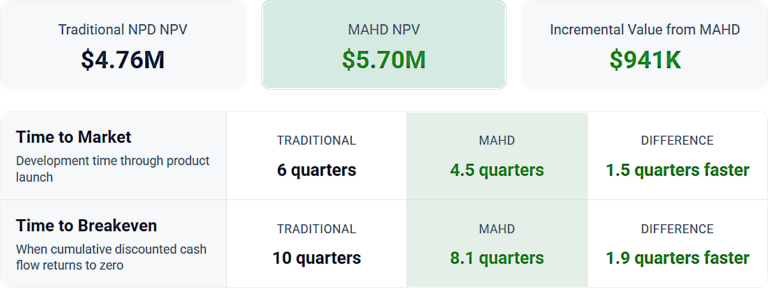
Any investment in process improvement must have a significant impact on an organization’s bottom line. Use the Project ROI Estimator below to compare the potential financial performance of a project using the MAHD Framework with your current product development approach.
Simply enter a few key project assumptions to estimate the potential effect on time-to-market, investment, profitability, net present value, and time to breakeven. Hover over the information icons for additional guidance on each input.
The model shows the impact of financial improvement from two distinct sources:
The estimator shows the potential impact of MAHD on a single project. When similar improvements are achieved across multiple product releases, development programs, and an entire product portfolio, the value can compound significantly.
Faster learning, earlier revenue, lower development costs, and stronger customer outcomes can collectively create a substantial competitive advantage.
Viewed at the portfolio level, adopting agile practices for hardware and physical-product development is not simply a process improvement initiative. It can become an important driver of sustained growth, profitability, and long-term competitiveness.
Enter the expected increase in total profit expected from using the MAHD Framework. This value can be difficult to estimate, but potential sources of improvement include:
Our experience indicates that organizations implementing MAHD generally improve the value delivered to customers, although the resulting financial impact varies by product and market. When project-specific data is unavailable, a 10% profit improvement is typically a reasonable and relatively conservative starting assumption.
After changing any assumptions, click UPDATE RESULTS to recalculate and see the comparison between the Traditional and MAHD approaches across several measures, including:
Click along the graph to compare the financial difference between the two approaches at each quarter.
Compare the projected financial value of a traditional new-product-development approach with a faster, more focused MAHD approach.
Both approaches are shown on the same scale. A higher line represents greater financial value at that point in the project. Click along the graph to see the difference each quarter.
The benefits of speed and higher customer value come from several key underlying factors:
The MAHD Framework, grounded in agile principles, drives significant improvements in these areas—delivering tangible benefits in increased speed, higher customer value and more predictable outcomes.
Whether you are evaluating agile for hardware, ready to pilot a project, or looking for answers to specific challenges, we have resources to help you move forward in your agile journey.
Understand why hardware development requires a purpose-built agile approach.
Overview • Benefits
Comparisons
Explore customer results, industry applications, and MAHD ROI.
Customers • Industries
Case Studies • ROI
Build capability through training, and practical implementation support.
Training • Workshops Certification
Find answers to questions about MAHD, challenges, and how it might fit in your organization.
Browse FAQ • Resources
Contact Us
Learn how MAHD applies agile principles to the real world of hardware. Key elements, benefits, how to get started.

Offered the 2nd Tuesday of each month, this 90-Min Seminar is a great way to learn if MAHD is right for you.
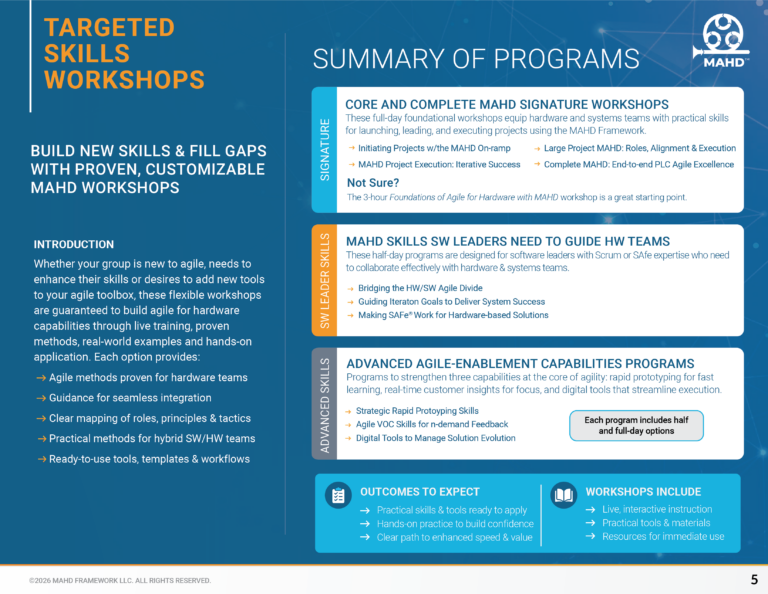
From basic to advanced skills, MAHD workshops provide the skills and tools to succeeed.

We’re here to help. Set up a complimentary 30-minute session with a MAHD expert to discuss your situation, goals and best path to success.