



See how teams used MAHD to surface critical decisions
earlier, reduce rework, and move complex hardware
programs forward with greater speed and confidence.
Oberved across MAHD implementations
More timely, sticky decisions
Aligned, satisfied stakeholders
More Predictable outcomes

Traditional processes were not meeting their time-to-market goals, but slowing down to transorm was not an option.


Aligning on requirements consumed an excessive amount of time and energy while delivering little meaningful value.

Solutions included premium features customers did not value, forcing the company to discount prices and accept lower margins.

A satellite communications oganization used MAHD to help technical and product leaders improve decision-making across a range of projects without pausing project execution or being traumatized by process change.
Leadership wanted greater company-wide agility as time-to-market pressure increased than their gate-based process could deliver. But the work involved complex technical decisions, delivery commitments, rigid certification and little appetite for a long and time-intensive transformation program.
The practical question was how to leverage agility to accelerate projects while learning agility at the same time.
With multiple projects sharing key team members, pilot selection, leadership buy-in and transparency were key factors to address.
Develop the bridge between existing methods, roles and conditions to identify pitfalls early.
Apply MAHD methods with one pilot project while considering potential wins and impact on the portfolio.
Leverage pilot insights to strengthen roles, methods, decision-making and the rollout approach.
Under the company’s existing approach, any change in scope, unexpected technical challenge, or dependency delay triggered the same response: compress the activities planned for later in the project to preserve the appearance that delivery remained on schedule. The results were predictable. Over the previous five years, not a single project had met its target schedule; every project finished at least six months late, and many overran by far more.
This pattern had to change. The breakthrough came not from tighter schedule management, but from fundamentally changing how decisions were made, escalated, and resolved throughout the governance structure.
| Before MAHD | With IPAC Iterations | Example Impact |
|---|---|---|
| Tradeoffs often surfaced late, were deferred, or had to be revisited | Cross-functional tradeoffs were surfaced and addressed through planned IPAC iterations | A critical debate over which bus to use for diagnostic data became a focused learning cycle. In the next IPAC iteration, the team built a vertical slice, evaluated the options with evidence, and reached a decision. |
| Decision roles and methods were unclear, leading to repeated escalation, delays, and miscommunication | The team quickly aligned on the decision approach, criteria, timing, required evidence, participants, and owner | Before gathering evidence, the team aligned on the criteria, impacts, participants, and decision owner for the diagnostic bus. That clarity enabled a faster decision that held. |
| Schedules quickly lost credibility and became a source of skepticism | The team demonstrated tangible progress as schedule variability steadily declined, supported by clear rationale and learning milestones | Schedule conversations shifted from “What can we eliminate from the schedule?” to “Given these strategic constraints, how might we optimize the project’s priorities?” |
Ken G. – VP Engineering
Teams knew who owned each decision, how it would be resolved, and when broader alignment was required.
IPAC Iterations gave leaders a structured, repeatable forum to surface tradeoffs, resolve critical issues, and make consequential decisions earlier.
Earlier decisions, visible dependencies, and rapid risk resolution reduced avoidable delays and helped teams maintain momentum toward key milestones.
A visible decision rhythm, transparent communication of schedule and risk, and demonstrable progress gave project leaders and executives greater confidence in the path forward.
An industrial automation company used MAHD to help a cross-functional team reduce front-end churn and converge earlier on a next-generation flow-measurement solution grounded in customer value, technical evidence, and product economics.
The organization was developing the next generation of a sophisticated flow-measurement solution for industrial customers with very different applications, operating environments, and priorities. Mechanical, electronics, firmware, product management, manufacturing, service, and compliance teams all had legitimate requirements—but no practical way to distinguish essential customer outcomes from preferences, legacy assumptions, and low-probability edge cases.
Alignment became a recurring cycle of workshops, requirements reviews, and document revisions. The volume of discussion created the appearance of rigor, yet the team was not materially reducing uncertainty or improving the solution.
The practical question was how to preserve technical discipline while reaching useful front-end decisions much faster.
Use Vision Briefs and Customer Outcomes to clarify target users, operating contexts, business constraints, and what would make the new solution meaningfully better.
Use the Focus Matrix to connect Customer Outcomes with Solution Elements and expose the intersections carrying the greatest value, uncertainty, and technical risk.
Use Prototype Plans and Flexible Fidelity Prototypes to test sensing performance, installation, integration, communications, and user interaction without waiting for a complete product.
Use IPAC Planning and Reviews to update the solution, requirements, architecture, and cross-functional plan together—committing as the evidence became strong enough.
Before MAHD, the team tried to create certainty by increasing detail. Each functional concern could become another requirement, and every new requirement created dependencies across the sensor, electronics, firmware, enclosure, communications stack, manufacturing, service, and certification. Meetings grew longer while confidence improved only marginally.
MAHD changed the sequence. The team first aligned on customer outcomes and the few decisions that would materially shape the product. Focused prototypes then produced evidence for those decisions. Requirements matured after learning—not in place of it.
| Previous Front End | MAHD-Enabled Front End | Likely Impact |
|---|---|---|
| Stakeholder requests were translated directly into features and requirements, even when the underlying customer outcome was unclear. | Vision Briefs and Customer Outcomes separated true needs from preferred solutions, legacy conventions, and edge cases. | Low-value premium features could be removed, deferred, or offered as options—reducing product complexity and protecting margin. |
| Functions debated requirements from within their own domains; tightly coupled tradeoffs surfaced late or were repeatedly reopened. | The Focus Matrix connected Customer Outcomes to Solution Elements, revealing the few intersections where tradeoffs and uncertainty mattered most. | Reviews became focused on priority decisions and required evidence rather than reconciling every possible requirement. |
| The team attempted to specify the complete product before high-risk assumptions about measurement performance, installation, diagnostics, connectivity, and service were tested. | Prototype Plans used several fit-for-purpose prototypes to test critical unknowns independently and in thin vertical slices. | Feasibility gaps and customer reactions surfaced while options were still inexpensive to change. |
| Requirements, architecture, estimates, and functional plans matured as separate deliverables, creating repeated handoffs and churn. | IPAC Planning and Reviews evolved the solution, requirements, architecture, and cross-functional plan together. | Dependencies became visible earlier, commitment was based on demonstrated learning, and front-end churn decreased. |
Robert S. – Director, Product Management
Customer Outcomes connected product choices to what users were trying to accomplish—not simply to features stakeholders requested.
Requirements evolved and were locked down when evidence showed they mattered, reducing low-value complexity and improving traceability.
Focused prototypes resolved consequential performance, integration, installation, and usability unknowns before the team committed to the complete system.
Fewer low-value features and clearer configuration choices reduced unnecessary cost while supporting differentiated offerings and healthier margins.
A commercial robotics company used MAHD to refocus a technically ambitious autonomous cleaning platform on the outcomes customers were willing to pay for—simplifying the offering, strengthening price integrity, and improving margin potential.
The company had built a capable commercial floor-cleaning robot with increasingly sophisticated autonomy, sensing, software, reporting, and workflow features. Each addition was technically defensible, and many responded to legitimate stakeholder requests. Together, however, they created a premium solution whose cost and complexity grew faster than customers’ willingness to pay.
Sales teams were left to close the value gap through discounts. The company absorbed the cost of premium hardware, software, validation, training, and service while accepting lower prices and shrinking margins. Yet indiscriminate cost-cutting could compromise cleaning performance, reliability, safety, or meaningful differentiation.
The challenge was to determine which capabilities truly earned their place in the core product, which belonged in segment-specific options, and which should no longer consume development and lifecycle investment.
Use Vision Briefs and Customer Outcomes to distinguish what priority segments needed to accomplish—consistent cleaning, dependable uptime, safe autonomous operation, simple deployment, and efficient service—from the features assumed to deliver those outcomes.
Use the Focus Matrix to connect Customer Outcomes with Solution Elements and identify where customer value, differentiation, product cost, technical risk, and lifecycle burden intersected.
Use Prototype Plans and Flexible Fidelity Prototypes to evaluate cleaning performance, operator workflows, service access, fleet visibility, and premium capabilities in realistic customer environments before committing them to the full product.
Use Flexible Architecture, Solution Evolution, and IPAC Planning and Reviews to evolve the core robot, optional modules, software, cost targets, and cross-functional delivery plan as evidence accumulated.
Before MAHD, the organization treated additional capability as the safest path to a competitive product. Features entered the baseline through customer requests, competitive comparisons, technical opportunities, and internal advocacy. Without a shared way to weigh customer value against system and lifecycle cost, the premium configuration gradually became the default.
MAHD changed the sequence. The team aligned first on the outcomes each priority segment valued, then identified the product decisions with the greatest economic and technical consequences. Focused prototypes and field learning tested those assumptions before the full system absorbed them. Product architecture, configuration strategy, cost, service implications, and customer evidence matured together.
| Previous Product Decisions | MAHD-Enabled Product Decisions | Likely Impact |
|---|---|---|
| Customer and sales requests entered the backlog as features, even when the underlying outcome or willingness to pay was unclear. | Vision Briefs and Customer Outcomes separated the job customers needed done from a particular feature request and clarified differences among priority segments. | The core offer could concentrate on outcomes broadly valued across the market rather than accumulating every requested capability. |
| Premium hardware and software capabilities were bundled into the standard solution, carrying their product and lifecycle costs into every sale. | The Focus Matrix made the relationship among customer value, differentiation, technical risk, cost, validation, and service burden visible. | Features could be retained in the core, offered selectively, simplified, deferred, or removed with a shared rationale. |
| The team relied on increasingly complete robots to learn whether new capabilities worked and mattered in practice. | Prototype Plans combined focused engineering rigs, workflow simulations, service trials, and limited-function field tests to answer specific product and value questions. | Customer reactions and operational limitations could surface earlier, before expensive integration and production commitments. |
| Product definition, architecture, costing, pricing, and launch planning progressed through separate functional decisions. | Flexible Architecture and IPAC Planning and Reviews evolved the core platform, options, economics, and delivery plan as one cross-functional system. | The company could support meaningful differentiation with fewer one-off variants and a more coherent product and pricing strategy. |
The base product could center on the outcomes most customers consistently valued—cleaning performance, uptime, safe operation, and ease of deployment and service—rather than maximum feature count.
Capabilities that did not earn a place in the core could be simplified, deferred, removed, or offered selectively, reducing unnecessary burden across the bill of materials, software, validation, training, and service.
A clearer separation between the shared core and optional capabilities could serve distinct segments without multiplying one-off configurations or fragmenting the underlying architecture.
Better value–cost alignment could reduce avoidable product and support expense, limit discount dependence, and provide a stronger basis for charging a premium where differentiated capabilities genuinely mattered.
Whether you are evaluating agile for hardware, ready to pilot a project, or looking for answers to specific challenges, we have resources to help you move forward in your agile journey.
Understand why hardware development requires a purpose-built agile approach.
Explore customer results, industry applications, and MAHD return-on-investment.
Customers • Industries
Case Studies • Project ROI
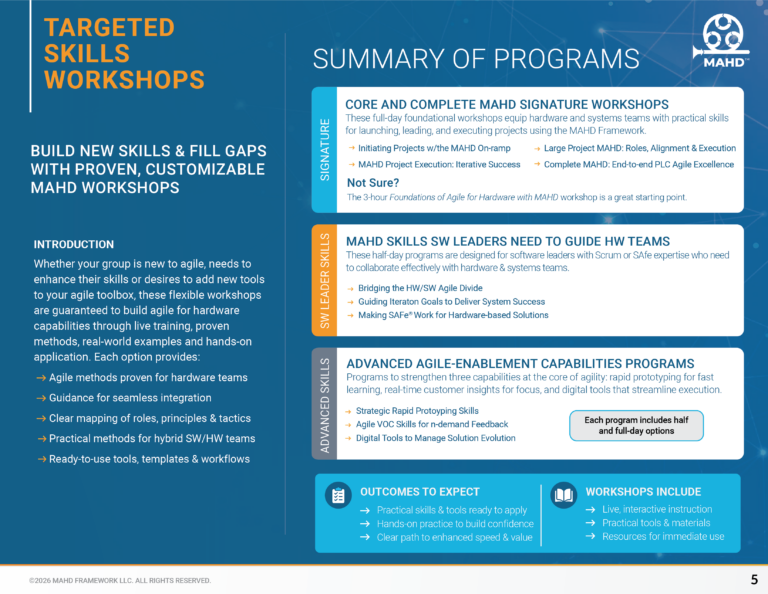
Build capability through workshops, training, coaching, and practical implementation support.
Training • Workshops
Coaching • Certification
Find answers to common questions about MAHD, implementation, and how it fits your organization.
Browse FAQ • Find Resources
Contact Us
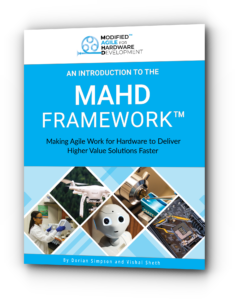
Your guide to applying agile principles in the real world of hardware development.
Learn the core elements of the MAHD Framework
Understand how MAHO accelerates time to value
See how leading companies achieve better results
Perfect for executives, engineers. and agile practitioners
We’re here to help. Talk with a MAHD expert about your situation and goals.