Purpose-Built Agile for Hardware Works Across Industries
MAHD turns complex hardware development into a faster, more predictable path from concept to market—without sacrificing technical rigor, governance, quality, or compliance. It brings physical products, electronics, software, manufacturing, supply chains, and long-lead decisions together within one practical operating model.
Across industries, organizations have used MAHD to learn sooner, expose risk earlier, reduce wasted effort, and achieve measurable results.
Different Industries. A Common Development Reality.
Learn Earlier • Integrate Sooner • Adapt with Control
Medical devices must satisfy regulatory pathways. Semiconductors face relentless technology cycles. Industrial systems may operate for decades. Defense programs must balance evolving mission needs with rigorous assurance. The constraints differ, but the underlying development problems are remarkably consistent; critical learning arrives too late, integration problems surface after major commitments, and traditional governance makes adaptation incredibly painful.
MAHD changes that pattern.
It gives organizations a practical operating model for learning earlier, integrating sooner, making better decisions, and adapting within the controls their industry requires.
Explore MAHD in your industry
Jump directly to the challenges, opportunites and resources most relevant to your organization
Rapid technology change, complex component dependencies, and demanding product schedules make electronics development especially vulnerable to late discoveries and costly redesign.
Typical Challenges
Fast-changing technologies and customer expectations
Hardware, firmware, and software integration dependencies
Component availability, obsolescence, and supply-chain uncertainty
High cost of design changes after architecture and tooling decisions
Embedded solutions can make identifying differentiating value difficult
How MAHD Can Help
Aligns strategy and performance priorities
Accelerates customer and technical learning before change becomes costly
Uses rapid prototypes and Solution Evolution to test assumptions early
Balances subsystem cost, schedule, and supply risk
Unifies engineering, product, and manufacturing execution
Recommended Resources
E-book
A Smarter Path to High-Value Solutions
Goes deeper into the challenges and opportunities of applying agile methods to electronic devices.
How a Pilot Team Made Faster, Better Project Decisions
A focused MAHD rollout helped technical leaders clarify ownership, improve governance, and resolve critical decisions earlier across three complex hardware pilot projects.
Medical-device teams must improve development speed while maintaining disciplined risk management, traceability, verification, and regulatory evidence.
Typical Challenges
Regulatory, quality, and documentation requirements
Patient and user risks that must be managed throughout development
Extensive verification, validation, and traceability needs
Limited flexibility once designs enter formal approval processes
How MAHD Can Help
Integrates iterative learning with existing quality and regulatory systems
Uses Embedded Governance to maintain appropriate controls without slowing every decision
Connects prototypes and development activities to defined learning objectives
Helps teams identify risks, usability concerns, and customer needs earlier
Recommended Resources
E-book
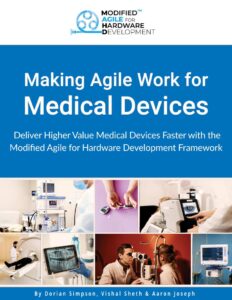
MAHD for Medical Devices: Deliver Higher Value Solutions Faster
Dive into the challenges and opportunities to apply Agile methods to address regulatory, traceability and other industry needs.
Industrial devices and systems—including energy, power, test, measurement, and process-control equipment—often combine complex engineering, manufacturing constraints, customer-specific requirements, and long operating and delivery commitments.
Typical Challenges
Long development, procurement, manufacturing, and certification lead times
Customer-specific configurations, operating environments, and product variants
Coordination across mechanical, electrical, software, manufacturing, and field teams
High cost of full-scale prototypes, late technical discoveries, and field correction
How MAHD Can Help
Focuses early learning on the highest-risk and most expensive assumptions
Uses scalable prototypes, simulations, and focused testing before major commitments
Applies Flexible Architecture to manage variants and long-term product evolution
Identifies integration, manufacturability, reliability, and schedule risks earlier
Recommended Resources
E-book
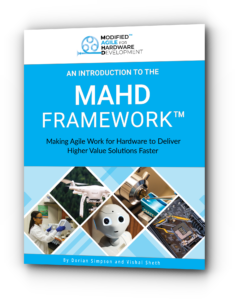
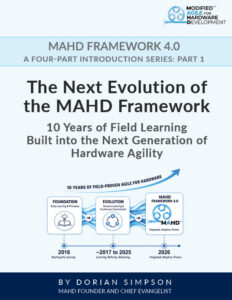
Intro to the MAHD Framework
Dive into the challenges and opportunities to apply Agile methods to address regulatory, traceability and other industry needs.
How One Team Streamlined the Front End of Development
MAHD replaced prolonged requirements debate with customer-outcome framing, focused tradeoffs, and early evidence—helping the team converge on a more valuable, technically grounded solution.
Robotics development requires mechanical, electrical, controls, sensing, and software elements to operate as one integrated system in unpredictable real-world conditions.
Typical Challenges
Tightly coupled engineering disciplines
Difficult-to-predict system behavior outside the laboratory
Repeated integration and performance problems
Changing application, customer, and operating-environment requirements
How MAHD Can Help
Organizes cross-disciplinary work around integrated system outcomes
Uses targeted prototypes to test movement, sensing, controls, and field behavior
Promotes frequent integration rather than end-of-program
Converts prototype and field observations into prioritized development decisions
Recommended Resources
E-book
Intro to the MAHD Framework
Dive into the challenges and opportunities to apply Agile methods to address regulatory, traceability and other industry needs.
How a Robotics Team Rebuilt Its Offering Around Customer Value
By exposing which capabilities customers valued—and the cost and complexity they created—the team shaped a stronger core offering, a more scalable platform, and healthier margin potential.
Defense and aerospace programs combine mission-critical performance, complex system integration, rigorous assurance requirements, and long development and service lifecycles. Teams must adapt as threats, technologies, and mission needs evolve—without losing control of safety, compliance, cost, or configuration.
Typical Challenges
Complex integration across hardware, software, communications, and human systems
Rigorous safety, security, compliance, and verification requirements
Long acquisition cycles, fixed milestones, and evolving mission needs
High cost of late discoveries, redesign, testing, and certification
How MAHD Can Help
Focuses early learning on mission critical technical and project risks
Uses prototypes, simulations, and incremental integration to expose problems early
Applies Embedded Governance to maintain control, traceability, and decision discipline
Uses Flexible Architecture and Solution Evolution to accommodate changing technologies and needs
Recommended Resources
E-book
MAHD for Medical Devices: Deliver Higher Value Solutions Faster
Dive into the challenges and opportunities to apply Agile methods to address regulatory, traceability and other industry needs.
How a Pilot Team Made Faster, Better Project Decisions
A focused MAHD rollout helped technical leaders clarify ownership, improve governance, and resolve critical decisions earlier across three complex hardware pilot projects.
Whether you are evaluating agile for hardware, ready to pilot a project, or looking for answers to specific challenges, we have resources to help you move forward in your agile journey.
Want to Learn More?
Understand why hardware development requires a purpose-built agile approach.