Since MAHD’s official launch in 2017, the framework has empowered countless teams to accelerate product development and achieve superior outcomes. Learn how it has evolved and how MAHD 4.0 takes organization agility to a new level.
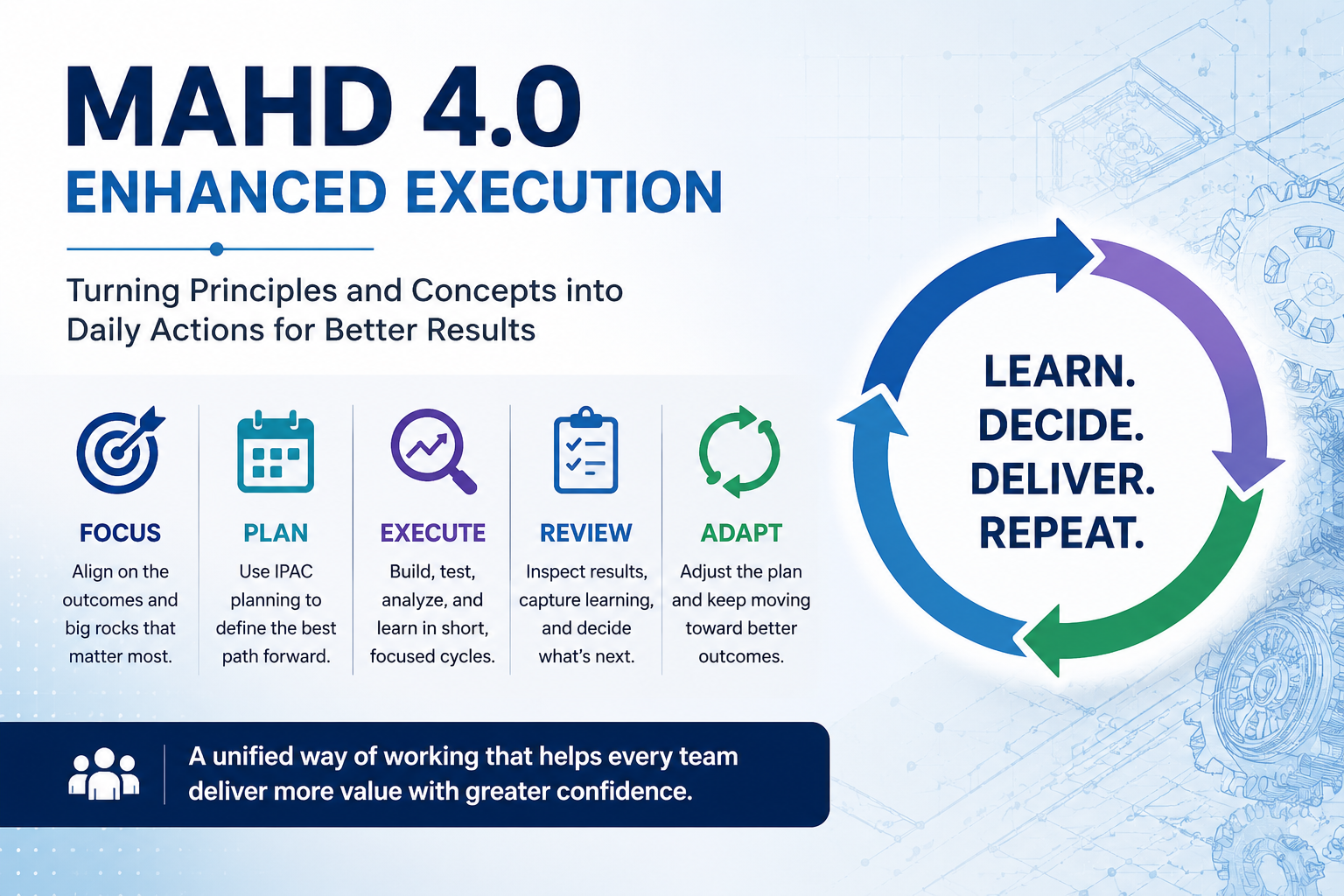
Each release of the MAHD Framework incorporates lessons from every implementation and project, along with feedback from teams, leaders, and stakeholders across the organization. These insights continually strengthen MAHD’s ability to:
Help teams deliver optimal solutions as quickly as possible
Extend agile benefits beyond project management and across the full product lifecycle—from concept through sustaining engineering
Clarify essential roles and make them more effective
Integrate seamlessly with existing processes, making agile transformation easier and less disruptive
Provide the learning and support tools needed to accelerate adoption and implementation
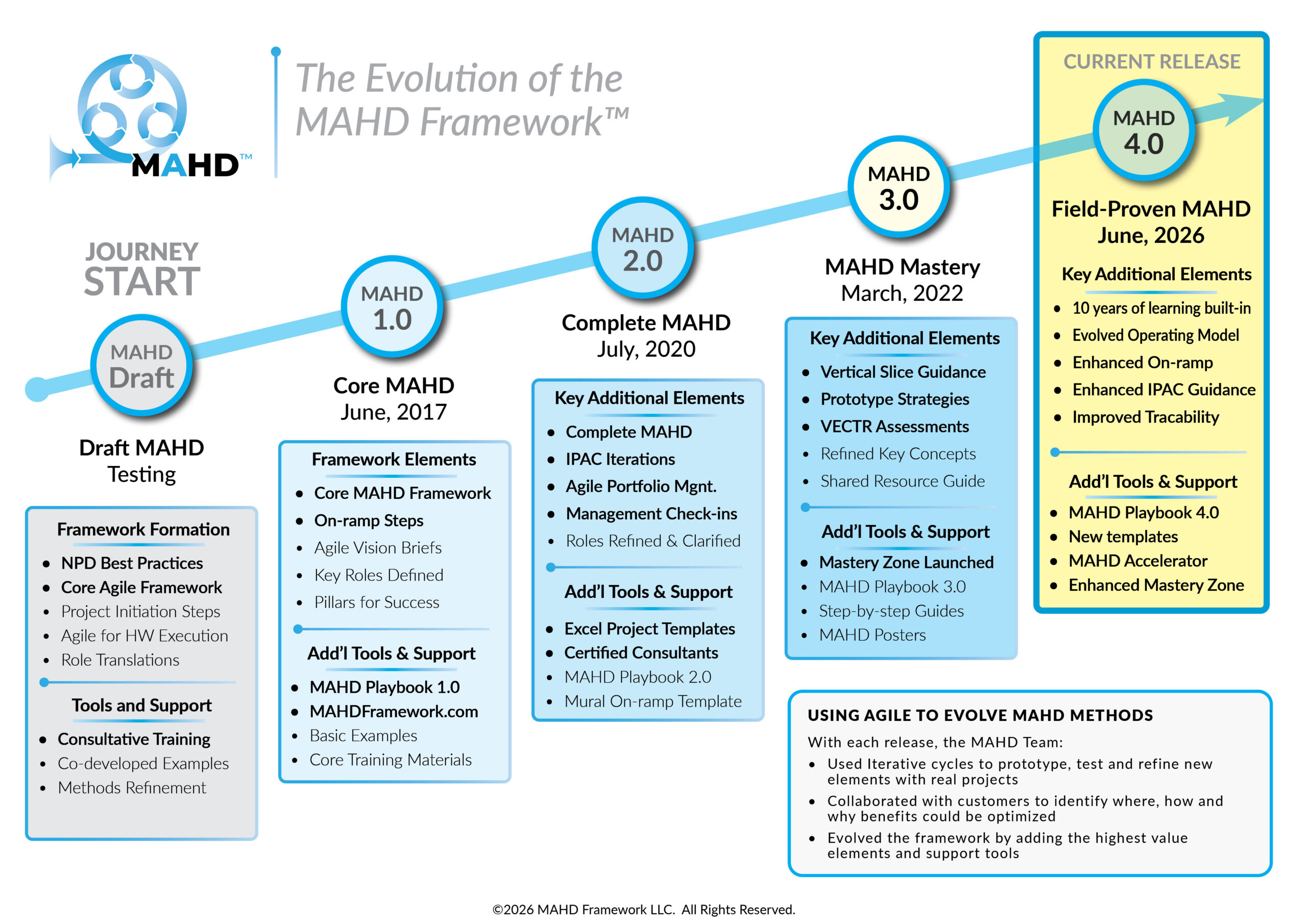
Each major release has advanced MAHD in an essential area. MAHD 2.0 introduced the Complete MAHD Framework, extending agile benefits across the full product lifecycle. MAHD 3.0 added the MAHD Mastery Zone, providing ongoing learning, support resources, and certification. Now, MAHD 4.0 takes the framework to a new level—making it easier to learn, faster to implement, and more effective to scale across the organization.
MAHD 4.0 incorporates insight from 100’s of projects over 10 years to make the framework faster to learn, easier to implement, and more resilient to old habits.
Learn why MAHD 4.0 is the most significant release since the launch of the framework.
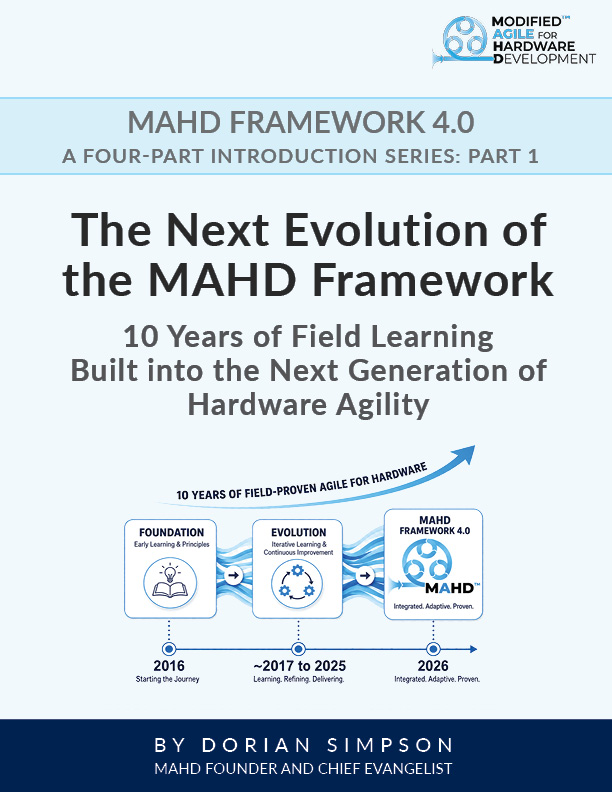
The MAHD Framework began with a simple but important question: Could the benefits of agile be adapted to the realities of hardware and physical-product development?
As early as 2011, MAHD’s founders recognized the limitations of traditional practices and the potential of agile to improve speed, learning, and customer focus. However, most agile methods had been designed for software and did not adequately address the longer lead times, physical dependencies, technical risk, trade-off decisions, and cross-functional coordination required in hardware development.
Through iterative experimentation and intensive research, the team worked closely with early adopters to identify what could be applied directly, what needed to be adapted, and where entirely new practices were required. These formative efforts established the foundation for what would become the MAHD Framework.
By 2014, the emerging principles and methods were being tested more broadly across a range of products, organizations, and industries. Led by Dorian Simpson, in collaboration from product leaders, engineers, executives, and practitioners, the framework evolved to solve real-world challenges with practical methods that align with the needs of hardware-based systems and solutions.
MAHD 1.0 officially launched in 2017. Soon afterward, MAHD Framework LLC was established to help hardware-based organizations get the benefits of agile methods through training, consulting, and coaching.
MAHD combines the strengths of agile principles with the practical needs of complex product development. Its methods emphasize:
The MAHD Framework continues to evolve through experience, feedback, and ongoing collaboration. Each relesae has refined the methods, tools, and guidance to make the framework easier to learn, faster to apply, and more effective in helping teams deliver better products with greater speed, focus, and confidence.
The MAHD 4.0 update is designed to make the framework easier to learn, faster to implement, and more likely to stick in daily practice. The goal was not to change the proven structure of MAHD, but to strengthen how teams understand, apply, and sustain it across real hardware projects.
Over the past ten years, we have observed how teams use MAHD across different industries, organizations, project types, and levels of complexity. We have seen what works well, where teams gain momentum quickly, and where teams struggle to connect the framework to the decisions, meetings, and planning activities that shape day-to-day execution.
With 4.0, teams going MAHD will see small changes that lead to big improvements. Some areas this release focuses on includes:
1) Connecting Principles to Action
MAHD 4.0 makes principles more practical by closely linking them to operating concepts, enabling capabilities, and day-to-day tactics.
2) Providing an Enhanced MAHD On-ramp
MAHD 4.0 refines project initiation guidance to help teams clarify intent, align faster, explore better options, and create stronger iteration plans.
3) Making Iterative Planning and Execution More Efficient and Stickier
MAHD 4.0’s updated execution guidance helps teams apply MAHD more flexibly and consistently with each meeting and conversation without drifting back into traditional waterfall habits.
Contact us to learn more how you can take your agile for hardware implementation to the next level.
We’ve applied insights from hundreds of projects and teams across nearly every industry—from startups to Fortune 50 companies—to evolve the MAHD Framework into one of the most practical, flexible, and powerful approaches to product development.
MAHD Release 3.0 provides even more indepth guidance for teams to effectively and efficiently develop and align on IPAC Iterations with an emphasis on advanced Agile practices like vertical slice guidance, prototype strategies, and additional Agile portfolio management methods.
The framework became more sophisticated with step-by-step guides, shared resource management, and additional learning tools like MAHD Playbook 3.0 and posters to remind teams of key concepts.
MAHD 3.0 also introduced the MAHD Mastery Zone – a complete learning portal with videos of each step, complete resources such as templates and learning aids along with quizzes and FAQs.
Building upon the core, MAHD 2.0 introduced the Complete MAHD Framework to apply Agile methods across the full product lifecycle from concept to sustaining engineering. The release also made great leaps in clarifying key concepts to make iterative development and planning more practical for teams, such as the definition of IPAC Iterations to help teams focus on: Integration, Prototyping, Alignment and Customer engagement milestones.
MAHD 2.0 also enhanced the framework to include more detailed role definitions, project status reporting, management check-ins, and more in-depth support through Playbook 2.0 and extensive project templates. This release ensured that teams had comprehensive guidelines and tools for successful Agile execution in hardware projects.
The first official release of the MAHD Framework (1.0) was focused on adapting Agile methods to core methods for Agile project management of hardware development. It introduced essential elements such as core Agile practices, project initiation steps with the MAHD On-ramp, and role translations tailored to non-software environments.
This phase was driven by combining Agile and New Product Development (NPD) best practices aimed to provide teams with a solid foundation for applying Agile in hardware projects. Early tools included core training materials, basic templates and co-developed examples to refine the methods.
Whether you have used the MAHD Framework for years or are just getting started, we would love to hear from you. Contact us to share:
Help us shape the future of MAHD!
Whether you are evaluating agile for hardware, ready to pilot a project, or looking for answers to specific challenges, we have resources to help you move forward in your agile journey.
Understand why hardware development requires a purpose-built agile approach.
Overview • Benefits
Comparisons
Explore customer results, industry applications, and MAHD ROI.
Customers • Industries
Case Studies • ROI
Build capability through training, and practical implementation support.
Training • Workshops Certification
Find answers to questions about MAHD, challenges, and how it might fit in your organization.
Browse FAQ • Resources
Contact Us
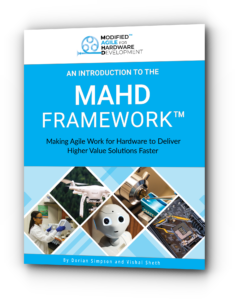
Learn how MAHD applies agile principles to the real world of hardware. Key elements, benefits, how to get started.
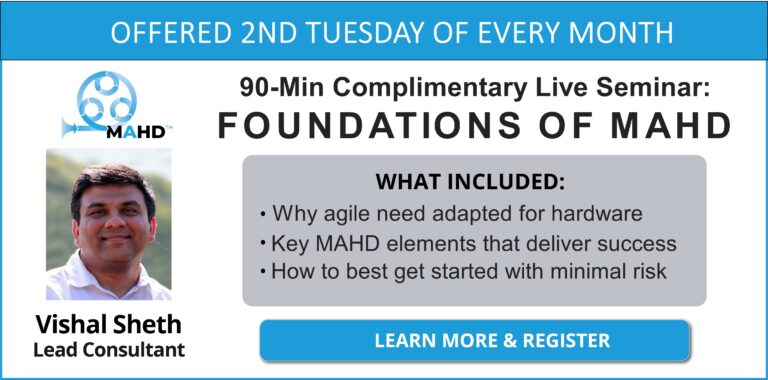
Offered the 2nd Tuesday of each month, this 90-Min Seminar is a great way to learn if MAHD is right for you.
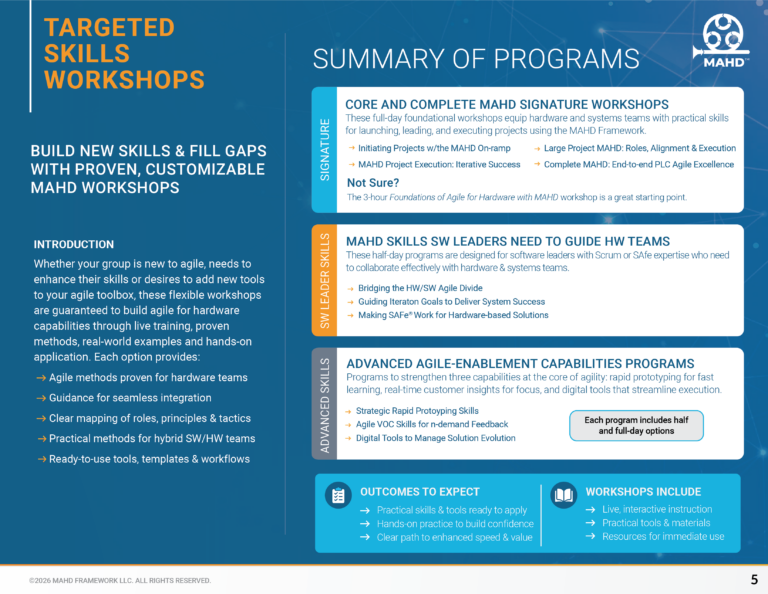
From basic to advanced skills, MAHD workshops provide the skills and tools to succeeed.

We’re here to help. Set up a complimentary 30-minute session with a MAHD expert to discuss your situation, goals and best path to success.